| Info |
Details |
| Growing Period |
90-150 days |
| Day Temp |
18-25ºC |
| Night Temp |
10-20 ºC |
| Soil |
Well-drained, light loam soil |
| pH |
5-7 |
| N |
100-150 kg/ha |
| P |
65-110 kg/ha |
| K |
160-240 kg/ha |
| Root length |
1.5m @ 60 days after transplanting |
| Transplant after |
25-35 days |
| Harvests |
3 |
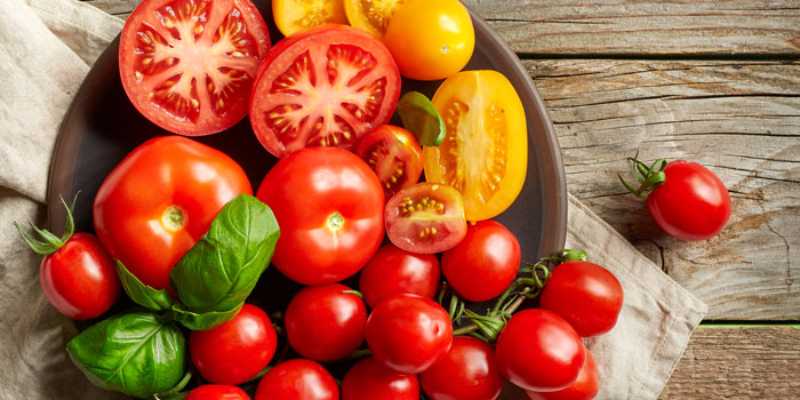
Tomato (Lycopersicon esculentum) is the second most important vegetable crop next to potato.
The present world production is about 100 million tons fresh fruit from 3.7 million ha. (FAOSTAT, 2001).
Low Yields
Low yield happens when there are:
- daytime temperatures above 25ºC
- night temperatures above 2OºC
- high humidity
- This leads to a greater incidence of pests and diseases and fruit rotting
- strong winds
- low sunshine
Yield decrease at various ECe values:
- 0% at ECe 2.5 mmhos/cm
- 10% at 3.5, 25% at 5.0
- 50% at 7.6
- 100% at ECe 12.5 mmhos/cm
Dry climates are therefore preferred for tomato production.
In the nursery, the row distance is about 10 cm. In the field spacing ranges from 0.3/0.6 x 0.6/1 m with a population of about 40,000 plants per ha.
The crop should be grown in a rotation with crops such as maize, cabbage, cowpea, to reduce pests and disease infestations.
The crop is moderately sensitive to soil salinity.
The most sensitive period to salinity is during germination and early plant development, and necessary leaching of salts is therefore frequently practised during pre-irrigation or by over-watering during the initial irrigation application.
Highest yields of salad tomatoes are obtained by frequent, light irrigation.
Where mechanical harvesting is used, heavy, infrequent irrigation is more appropriate with the last irrigation applied long before harvest.
High Yields
A good commercial yield under irrigation is 45-65 tons/ha fresh fruit, of which 80-90% is moisture.
The water utilization efficiency for harvested yield (Ey) for fresh tomatoes is 10-12 kg/m3